
Gut health is one of those things I never really thought about until my stomach apparently decided that it would like to become the main character in my life. Suddenly I was thinking about bloating after lunch, wondering why my digestion seemed perfectly happy one day and completely confused the next, and slowly realizing that perhaps living on coffee until noon and then eating whatever happened to be available was not exactly the wellness routine my body had been hoping for.
The funny thing is that when I first started reading about how to improve gut health naturally, everything sounded incredibly complicated. There were probiotics, prebiotics, digestive enzymes, fermented drinks, supplements I had never heard of and people on the internet casually making their own sauerkraut as if we all had several free afternoons per week to become fermentation experts. I didn’t want another complicated health routine. I wanted a few simple things that I could actually do without reorganizing my entire life around my digestive system.
So instead of trying everything at once, I started with a few basic changes. Nothing dramatic, nothing particularly expensive and definitely nothing that required me to drink a mysterious green liquid at six in the morning. These are the five things that made the most sense to me and that I now try to incorporate into my everyday life.
1. I Started Eating More Different Foods
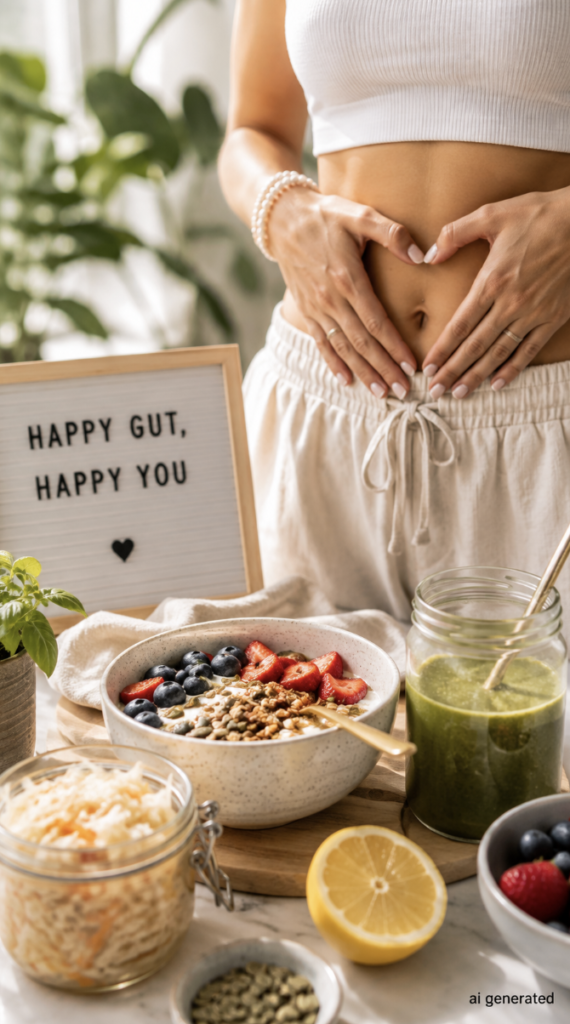
The first thing I changed was probably the simplest: I started paying more attention to variety. I used to think that eating healthily basically meant finding a few healthy meals and eating them repeatedly, which is how I somehow ended up having the same oatmeal for breakfast, the same salad for lunch and approximately four vegetables in permanent rotation for months at a time.
When I started learning more about gut health, I realized that variety is actually quite important because the microorganisms living in our gut interact with all the different fibers and nutrients we eat. So instead of trying to find the one perfect “gut health food,” I started trying to eat more different plant foods throughout the week.
And I mean this in the least complicated way possible. If I’m making oatmeal, I might add blueberries, raspberries, chia seeds and walnuts instead of just a banana. If I’m making pasta, I’ll throw in spinach, tomatoes, zucchini or whatever vegetables are sitting in my fridge looking increasingly concerned about their future. If I’m making a salad, I’ll add chickpeas, pumpkin seeds, herbs or some roasted vegetables rather than expecting three leaves of lettuce and a cucumber to carry the entire nutritional responsibility of the meal.
I also stopped thinking that every meal needed to be perfect. I simply try to make my food a little more colorful and varied whenever it’s easy to do so. Some days that means a beautiful bowl filled with vegetables, grains, herbs and seeds, and other days it means adding frozen peas to pasta because that is the level of culinary ambition available to me at that particular moment.
Both count.
One thing I did learn quite quickly, however, is that dramatically increasing fiber overnight is not necessarily a brilliant idea. If you currently eat very little fiber and suddenly decide that tomorrow you are going to become the queen of lentils, beans, chia seeds and raw broccoli, your digestive system may have some opinions about that decision. I found it much easier to gradually add more fiber-rich foods while also making sure I was drinking enough water.
For me, the goal isn’t to eat a flawless diet. I simply want to give my gut a wider variety of foods to work with, and that has made healthy eating feel much more relaxed.
2. I Added Fermented Foods Without Making It Weird
Fermented foods were one of those things I kept seeing whenever I searched for natural ways to improve gut health, and initially I assumed this meant I was going to have to start brewing something suspicious in a glass jar on my kitchen counter.
Thankfully, it does not.
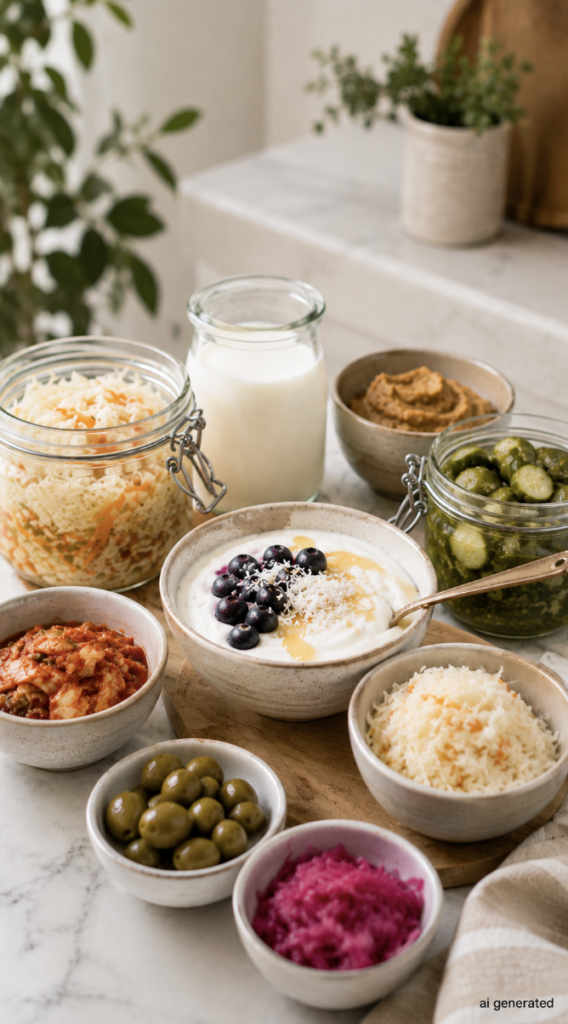
Fermented foods include very normal things like yogurt, kefir, sauerkraut, kimchi and miso, and I found that the easiest approach was simply to choose one or two that I genuinely liked and add them to meals I was already eating.
For example, I often have natural yogurt with berries, oats and nuts for breakfast, or I’ll add a little sauerkraut or kimchi to a bowl at lunch. Sometimes I use miso in a dressing or soup. There is no complicated schedule and I certainly don’t sit there at 8:15 in the morning thinking, “Oh no, I haven’t consumed my fermented food yet.”
I just keep some in the fridge and use them when they make sense.
I also started reading labels because not every product that looks incredibly wholesome and gut-friendly is necessarily what you imagine it to be. Some yogurts contain a surprising amount of added sugar, and some fermented products have been heat-treated after fermentation. I don’t obsess over it, but I do like knowing what I’m actually buying rather than being seduced by a beige package with leaves on it and the word “balance” written in an elegant font.
And again, I started slowly. I didn’t suddenly eat half a jar of kimchi because somebody online said fermented foods were good for gut health. When it comes to digestion, I have learned that introducing things gradually tends to be considerably more pleasant than approaching every new health habit with the enthusiasm of someone training for the Gut Health Olympics.
3. I Stopped Pretending Stress Had Nothing to Do With My Stomach

This was probably the least exciting realization because buying a new probiotic yogurt is much easier than admitting that perhaps being stressed from morning until bedtime is not doing your body any favors.
I used to think about stress and digestion as two completely separate things, even though my own body had been giving me fairly obvious evidence that they were connected. Before an important meeting, my stomach would suddenly behave differently. During stressful weeks, my digestion would be all over the place. Then I would go on holiday, sleep properly, walk around all day, eat pasta and dessert and somehow my stomach would suddenly decide that life was wonderful again.
Eventually I took the hint.
The gut and brain communicate with each other through what is often called the gut-brain axis, so taking care of stress is also part of how I think about taking care of my gut now. This does not mean that I have become an incredibly peaceful person who meditates beside a candle every morning while sunlight gently enters the room. I would love to tell you that is my life, but sometimes I am checking emails before I have even properly opened both eyes.
What I do try to do is create small moments during the day when I’m not rushing.
One of the biggest changes has actually been how I eat. I try not to eat every single meal while simultaneously looking at my phone, answering messages and mentally planning the next six things I need to do. When possible, I sit down and actually eat. Revolutionary, I know.
I chew more slowly, I take my time and I try to notice when I’m full instead of discovering twenty minutes later that I have eaten lunch without remembering any part of the experience.
I also walk a lot, take little breaks from my screen and sometimes do a few minutes of slow breathing when I notice that I’m particularly tense. None of these things are impressive enough to become a morning-routine video, but that is exactly why they work for me: they are easy enough that I actually do them.
4. I Started Walking After Meals

If I had to choose one gut health habit that requires almost no planning, costs absolutely nothing and makes me feel better almost immediately, it would probably be walking after meals.
I originally started doing this because I wanted to move more during the day, but it quickly became one of my favorite habits. After lunch or dinner, instead of immediately sitting back down at my desk or moving approximately three meters from the dining table to the sofa, I try to go outside for ten or twenty minutes.
It doesn’t need to be a serious power walk. I’m not putting on performance leggings, checking my heart rate or trying to break a personal record around the neighborhood. I literally just walk.
Apart from adding some movement to my day, it gives me a natural little break after eating. I get some fresh air, I’m away from a screen for a few minutes and I usually come back feeling much less heavy and tired than when I stay sitting down immediately after a meal.
I also stopped thinking that movement only “counts” when it is a proper workout. Of course I still love things like Pilates, strength training or longer walks when I have the time, but everyday movement matters too. Taking the stairs, walking to get coffee, doing a phone call while walking or going around the block after dinner are all incredibly easy ways to move more without turning exercise into another exhausting item on my to-do list.
The best kind of movement, at least for me, is the kind that fits so naturally into my day that I don’t need to negotiate with myself for forty-five minutes before doing it.
5. I Finally Started Taking Sleep Seriously

For years, sleep was the first thing I sacrificed whenever life became busy. I would stay up late working, scrolling or watching “just one more episode,” which is obviously one of the greatest lies we collectively tell ourselves, and then try to compensate the next morning with coffee.
Eventually I started realizing that if I wanted to feel better overall, I couldn’t spend so much time thinking about what I was eating while completely ignoring how much I was sleeping.
Sleep and our daily rhythms are connected with so many processes in the body, including digestion and metabolism, so I started treating sleep as part of my gut health routine rather than something completely unrelated.
The biggest thing that helped me was making my evenings slightly more boring, and I mean that as a compliment.
I try to go to bed at roughly the same time, I lower the lights, I stop working and I make an effort to put my phone away instead of getting into bed and accidentally learning everything there is to know about a stranger’s kitchen renovation at midnight.
I also try not to eat an enormous meal immediately before going to sleep because I personally don’t feel particularly good when I do. That doesn’t mean I have a strict rule about never eating after a certain hour; I simply pay attention to what makes me feel comfortable and what doesn’t.
And that, really, has become my entire approach to gut health.
I don’t want to spend my life trying to create the perfect microbiome. I don’t want a cupboard filled with twenty supplements or a morning routine that begins before sunrise just so I have enough time to complete it. I want to eat plenty of different foods, include some fermented foods when I can, move my body, manage my stress a little better and get enough sleep.
None of it is particularly glamorous, but that is probably why I have been able to stick with it.
If you’re trying to figure out how to improve your gut health naturally, I would start with one thing rather than trying to change everything at once. Add a few more plants to your meals this week, try yogurt or another fermented food you enjoy, take a little walk after dinner or go to bed thirty minutes earlier.
Then see how you feel.
Your gut health does not need to become another project you have to perform perfectly. Sometimes the simplest habits are the ones that make the most sense because they can quietly become part of your normal life — and personally, I will choose a ten-minute walk and a bowl of berries over a complicated twelve-step gut health protocol any day.
And if you feel like you’re doing all the “right” things but still regularly struggle with bloating, an uncomfortable stomach or that frustrating feeling that your digestion is simply never quite settled, my Gut Health Guide goes much deeper into the simple everyday changes that can help you support your gut without turning your entire life upside down. It’s actually the exact approach that helped my mum so much with the typical issues she had been dealing with for ages, especially bloating and feeling uncomfortable after meals, which is one of the main reasons I wanted to put everything together in one easy, practical guide in the first place.
Leave a Reply